
Other Ailments
Contents include:
Respiratory Ailments
The pollution is bad here, especially in the city centers during traffic rush hour.
The best things you can do are avoid the streets during traffic rush hour, live away from the street, and take back alley routes when reasonable.
Eye Infections
Eye infections are significantly more common here than in western countries. Some say that the pollution affects the eyes' ability to fight off infection. The ThailandGuru believes that you usually get eye infections by rubbing your eyes after handling doors, bus rails, and other things in public. Pollution might increase your tendency to rub your eyes, but some of the viruses and bacteria that cause eye infections are hearty and spread easily.
Resist the temptation to rub your eyes and nose, wash your hands regularly, and be careful what you touch. There's no reason to get neurotic about it, but don't be reckless, either.
Cuts and Scratches
Cuts and scratches may heal slower and get infected more often if you don't take precautions against the heat and sweat. Depending on the lesion, you might want to let them dry out when in a clean environment, and put on an antibiotic ointment and dressing when in public.
You should always, always, always clean out a cut as best you can with water and soap, and apply an antibiotic coating if you can. It's good to keep a broad spectrum antibiotic ointment in your medicine chest.
You should keep your tetanus vaccination current. It's a nearly painless shot every ten years. See the next section on tetanus.
Tetanus
Tetanus is caused by a bacterium (Clostridium tetani) that enters thru a wound, such as a cut or puncture. After multiplying in the human body, a toxin produced by the bacterium causes muscle contraction, e.g., lockjaw and other musculatory failures and spasms.
Tetanus is more prevalent in hot, moist climates which have a lot of organic matter in soils, though tetanus is everywhere in the world.
You can get tetanus by any wound. (Some people mistakenly believe it's mainly from rusty nails. Not true, though rusty nails have been a widely publicized common source historically.)
According to Wikipedia's article on tetanus, Thailand is one of the lesser tropical countries for tetanus, which does NOT mean there's less tetanus bacteria, and IS because Thailand has implemented a national immunization program since around 1980, whereby samples of 1,377 Thais' blood show that over 90% of Thais under the age of 60 have sufficient levels of antibodies against tetanus. If this were not the case, then the incidence of tetanus would surely be far higher in Thailand.
Some authorities recommended that everybody get a tetanus vaccination and check when they had their last booster, and I agree with this! In adults, the US CDC recommends a tetanus booster every 10 years. Getting a shot after a cut may not be enough in some cases, as it takes time for the antibodies to sufficiently rise in numbers. Symptoms typically appear 8 days after infection, but can come months later. The intensity of a case of tetanus can be mild to severe.
After receiving a minor puncture wound, I walked into a local suburban hospital (in Pathum Thani) and talked with a doctor, who thought my case was minor but was well aware of the 10 year booster recommendation, so that if I wasn't sure that I'd gotten a booster within the last 10 years, then a puncture wound is a good time to get a booster. It is a very small shot in the arm, about as painless as a shot can be, comparable to a mosquito bite (maybe thanks to a good nurse). Cost: 445 baht (US $ 15) for everything, the hospital doctor visit plus the shot -- in a suburban province.
I have since found that most Thais know about tetanus from school, and that immunization is indeed standard procedure here. So I suggest you get with the program, which will relieve yourself of another potential worry, in case you get a cut during your travels in an odd place or at a time when it's not so convenient to go to a hospital for a booster.
Typhoid
Typhoid, or typhoid fever, rarely occurs here, especially among foreigners, but it's occasionally heard of. It's caused by drinking water or eating food contaminated with feces from an infected person, and is due to the bacterium Salmonella typhi, aka Salmonella enterica enterica. An oral vaccination is available, but usually not necessary. Depends on where you're going to be living and how safe you want to be.
If you practice cleanliness and take simple precautions, your chances of getting typhoid are slim. The symptoms are high fever, complete exhaustion, headache and intestinal inflammation. It typically lasts for 3-4 weeks in various stages.
Tuberculosis
Tuberculosis is fairly common in southeast Asia. If you see someone coughing a lot, move as far away from them as you can. Of course, this is a general rule, but tuberculosis is one of the worst airborne diseases you can contract. It's rare for foreigners to contract it in Thailand, but it does happen. A light exposure does not mean you'll get symptoms of TB, as your body may fight it off completely.
Estimates are that one third of all people in the world have been infected by tuberculosis, though it varies widely between countries, from 80% in some countries to 5-10% in the USA. It's common for the body's natural defenses to fight it off like any other disease, and for the infection to go dormant, but approximately 10% of all infections progress to symptoms, and if untreated then about half of those result in fatality.
Tuberculosis is caused by various strains of mycobacteria, usually Mycobacterium tuberculosis in people.
Chronic cough is the best known symptom of tuberculosis but it can infect many other organs and cause a wide variety of symptoms.
You can get immunized against tuberculosis. However, you may already have natural immunity to it, as a skin test will determine.
If you do get tuberculosis, then it is vital that you complete your medication, as you will feel better long before you get over it completely, and drug-resistant tuberculosis arises because people don't complete their medication.
Coral Cuts and Abrasions
If you get cut by coral, you should be careful to thoroughly clean out all tiny fragments as soon as possible, and in the end apply an antiseptic. Coral cuts have a high risk of infection.
Jellyfish
Jellyfish are found all over the tropical world, and Thailand is no exception. While Thailand is not known as an exceptionally risky jellyfish country, nonetheless, I've come across many reports by people stung by jellyfish, occasionally including by one of the most poisonous jellyfish in the world, the box jellyfish (technically not a jellyfish, actually, since it has a brain and navigates itself to prey or away from danger like humans). The vast majority of jellyfish stings in Thailand come from one of the other 2000 species of jellyfish and are painful but not life threatening.
If stung, do not wash off the jelly with your hands. Use seawater. (Some say to use sand or a towel, but the stingers respond to pressure.) Applying vinegar immediately after the sting for 30 seconds can neutralize a lot of venom. It is recommended you take a couple of 20 baht bottles of vinegar with you if you want to prepare for possible treatment of jellyfish stings, as vinegar is the best remedy. It should be the policy of every resort to stock this, but I've never heard of this.
Victims have an acute reaction to stings. In the case of the most toxic jellyfish species (the box jellyfish), the victim may well get breathing problems and other convulsive symptoms, possibly requiring mouth to mouth resuscitation. Be aware and prepared to help. However, the vast majority of jellyfish stings are simply painful without more serious symptoms.
There were three reported fatalities from jellyfish stings in Thailand for the period up to 2007 -- one in 1999 in Koh Samui, and two in 2002 in nearby Koh Phangan in the southern Gulf of Thailand. All were box jellyfish, which are exceptionally poisonous. (Fully grown box jellyfish have a head about the size of a basketball.)
There has been about 1 fatality per week reported in the entire world on average, mainly from box jellyfish, which can be found all around the tropics. However, there is surely much under-reporting.
According to a Thailand Guru reader, Andrew Jones, whose son suffered a nearly fatal box jellyfish sting, there were 8 other reported box jellyfish stings in the five month period from December 2007 thru April 2008 in the Gulf of Thailand and the Andaman Sea, including a fatal incident on a Swedish girl aged 10 on Ko Lanta beach (near Phuket in the Andaman Sea).
While the risk is much less than driving down the road or walking beside it, it still helps to be aware, especially if you are an avid swimmer or diver.
Some have claimed that the issue of jellyfish has not been announced out of fear of the economic impact to tourism. There may be a grain of truth to this, but fears have a way of getting blown up all out of proportion, relative to other risk factors in life, and goodness knows tourists suffer far more from skinburns, cancer, excess alcohol and food consumption, driving motorcycles, and so on. (For example, Phuket island has 250 road fatalities and well over a thousand serious injuries on the road per year, but no jellyfish deaths yet.)
The best precaution is to swim with some protective clothing.
If stung, pour vinegar on your sting, as well as untouched tentacles. This works for all jellyfish, including the box jellyfish, to neutralize their venom which hasn't yet entered your bloodstream and their tentacles.
The rash from a jellyfish sting may last for about week. Calamine lotion is a popular application.
Jellyfish use their tentacles to capture prey for consumption. Most are brainless, just floating on autopilot.
You can sometimes see jellyfish washed up on shore. Of course, don't step on them nor pick them up, and educate your children likewise.
A scientific journal article by four co-authors following the 1999 Koh Samui death states "A review of Thai literature dealing with jellyfish in the Gulf of Siam, and Andaman sea, revealed only anecdotal reports of a few deaths following jellyfish contacts." Source: here
A fairly good short summary of the jellyfish threat is here:
here
There are over 2000 species of jellyfish, but less than 100 are dangerous to humans.
Some precautions and treatments are discussed here.
Four other sources: Australian Venom Research Unit, Tropical Australian Stinger Research Unit, Diver Alert Network (Asia-Pacific), and Dr. Peter Fenner.
Sea Urchins
Sea urchins are occasionally a problem. They just leave some spines in the skin. Don't worry too much about these. Be very careful and gentle when you try to pull them out, but don't be alarmed if they break and stay in the wound as they usually do. They're extremely brittle. However, the body will absorb then in a day to a few weeks, or else they will work themselves out on their own. You're usually better off not doing anything but trying to pull out any that you reasonably can, applying antiseptic, seeing a doctor, and just waiting for it to heal, which may take a month.
Skin Worms - Roundworm, Hookworm, Whipworm
People have been known to pick up skin worms in Thailand. It's rare but happens. Usually by walking barefoot in a place with the worms.
Snake Bites
Most snakes in Thailand are not poisonous, though some are, some dangerously so. Snakes are rare in Bangkok, almost unheard of in the city, though seen or found fairly often in suburban neighborhoods, and common in the provinces but not terribly so. Stories of people getting bitten are rare, as are people dying of a bite (I've never known anyone or their friends or relatives dying from a snake bite).
Snakes, by their common sense nature, do not want to attack humans or other big animals and will quickly retreat or hide. Snakes are more afraid of us than we are of them! They don't seek out to bite people. Just be careful not to threaten them or accidentally step on one. Most bites I've heard of come from people trying to trap and kill a snake. Vietnam War veterans will tell you the same.
If you get bitten by a snake, go straight to the emergency room of a local hospital. Try to remember what the snake looked like, but don't take a chance at getting bitten again.
Chulalongkorn Hospital on Rama 4 Road (near Lumpini Park and the Dusit Thani Hotel) has particularly good expertise on snake bites. The direct line is 256-4214. It's supposed to be open 24 hours per day, but if there's no answer or the line is busy, call the switchboard at 251-8932.
A good article on snake poison and treatment of bites is the Bangkok Post education article, but it doesn't cover the kinds of poisonous snakes in Thailand. Thus far, I haven't found anything on the web about Thailand's snakes which comes anywhere close to a book I've seen in bookstores.
There are cobras in Thailand, and some worse than cobras such as the Krait, but the most common poisonous snake in the Bangkok suburbs to be on the lookout for is the tree viper. Its bite is rarely fatal except possibly with very young or frail old people, but it causes pain, swelling, and temporary paralysis around the bite. In fact, I eventually had some experience with this one when the wife of one of my employees stepped on one barefooted and these are the symptoms she got for a few days.
In my suburban house, which is next to a lot of empty high grass fields and a canal, one year we had rats above the ceiling, often waking us up at night. Then, fairly suddenly, they disappeared. A few weeks after their disappearance, a strong bad smell came from the attic. We sent a guy up and he found a huge dead snake rotting, about 2 meters long, which had apparently crawled from a tree into the attic.
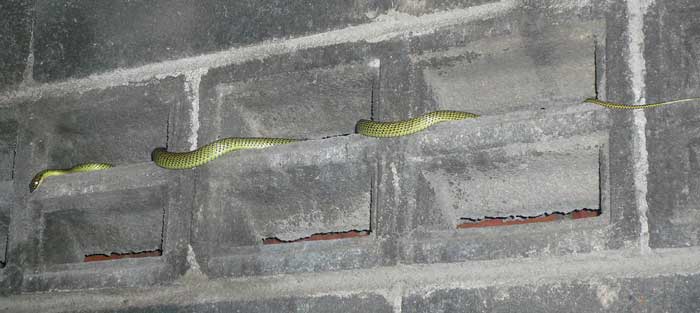
We have a few snake skins hanging around, had one fill a shoe and go to sleep by my front door, and I've seen a few around the yard over the years. I caught one in a bag (not recommended), and like the rats in my traps, drive them a couple of kilometers away then let them out into the wild. Otherwise, the security guards will kill them. Here's a photo I took of one I saw hanging out near a restaurant kitchen in 2008 (I guess eating little mice from the kitchen):
If you like snakes, there's the Snake Farm, or Saovabha Institute or Pasteur Institute, one places by three different names. If you're going to be hiking in snake country, there are booklets on snakes there. This is said to be the world's second oldest snake research facility. Established in 1923, it develops antivenoms and vaccines, and has more than a thousand snakes who serve both educational and medical purposes. They have a slide show and also snake handler shows. It's located on Rama 4 Rd. near Lumpini Park and is open daily from 8:30am to 4:00pm. The shows are at 10:30am and 1:30pm weekdays, and 10:30am on weekends. Admission is 70 baht per primate.
Tips
When given an antibiotic, it is important to finish the treatment, not stop when the symptoms go away. This is because you will usually feel better before all the bacteria are fought off. The small amount of surviving bacteria may be a tougher strain. If you don't finish the medication and if you don't fight off the small amount of surviving bacteria in your body, then you could get a relapse of tougher bacteria than before. It's simple natural selection. This is called drug resistance.
Verify prescriptions by Internet...
Quality of doctors...
Costs...
Insurance ...
www.drkoop.com
 > Family, Health and WellBeing > Other Ailments, Bites, Tips
Copyright 1999 -
2024 by Mark Evan Prado, All Rights Reserved.
Notably, I get quickly notified of copies of tracts by the CopyScape / CopySentry automatic search engine & notifier.
Short quotes are often OK and can be approved, if there is a clear reference and web link back to my website from the quoted material, and if you send me a short message. I try to help people with good intentions, and try to help the world. Not thieves. Links back to this website are helpful for sustainable progress, thank you!
Please have honor and class by following intellectual property and internet protocols. Be a good kind of person in life.
|
Want to privately ask the Thailand Guru? Contact us.
|
|
Some of the services discussed on Thailand Guru are provided by our friendly staff in our 2 companies: |
|
|
Lucky Lion Pride Co., Ltd.
|
|
| DISCLAIMER: Although efforts have been made to ensure the information on this website was correct at the time of electronic publication, ThailandGuru and all its associates do not assume and hereby disclaim any liability to any party for any loss or damage caused by errors, omissions or misleading information resulting from negligence, accident or any other cause. If you choose to take any of this advice, it is at your own risk and no other entity's. ThailandGuru and its associates will take no responsibility. The only thing we guarantee is that our website information can take bandwidth, memory and/or disk space, at least temporarily. Guru is relative. | |
Menu: Site Map