
Bangkok, Thailand, Houses, Condominiums, Apartments
Viewing houses, condominiums or apartments starts with choosing the right location. Bangkok is vastly spread out, as a city of approximately 8 million people, and Thailand is as tall as the U.S. west coast.
In the Bangkok region, approximately half of all expats want to be in the central business district (CBD), or somewhere along the two skytrain routes serving that area, namely on or near Sukhumvit-Phloenchit Rd. or the Silom subdistrict. This area is almost purely highrise luxury condominiums and serviced apartments, though there are some individual homes and townhouses scattered around, sandwiched within the concrete maze.
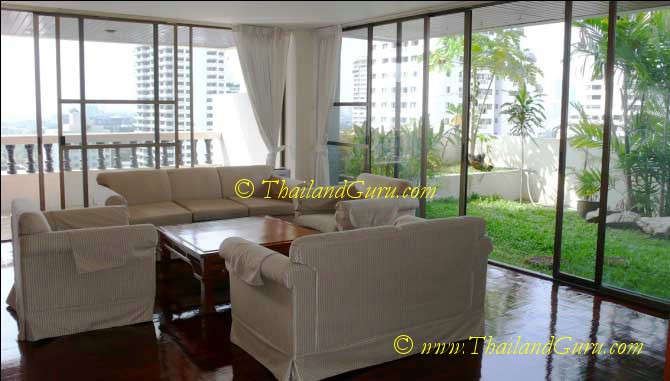
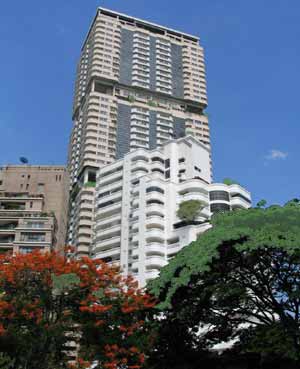
For example, you can have a living room raised high into the sky:
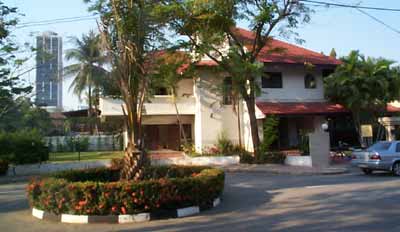
Or, you can get more down to Earth in a spacious suburban neighborhood house:
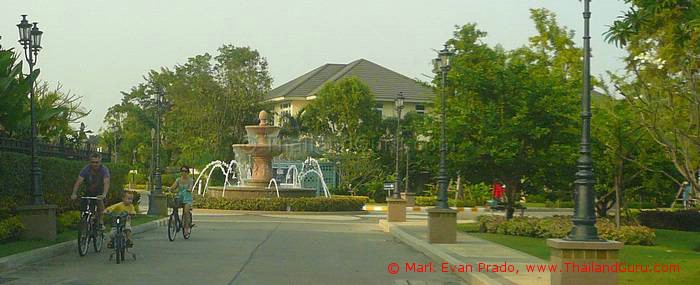
For example, if you want your children to be able to bicycle around the neighborhood, then you'd better head for the suburbs. The above expats chose an inner suburb along the Ekamai - Ram Indra expressway. They can also drive to a nice western grocery store in the suburbs and a wide variety of restaurants without needing to deal with central Bangkok's traffic.
Approximately half of expats are spread around Bangkok's suburbs, and are usually those who prefer a house (especially those who want a new house, since most houses in the central business district are old) and a quiet, spacious neighborhood, or else more economical housing, and/or to experience the Thai way of life (middle to upper class Thai). New housing estates near the expressways have many expat residents.
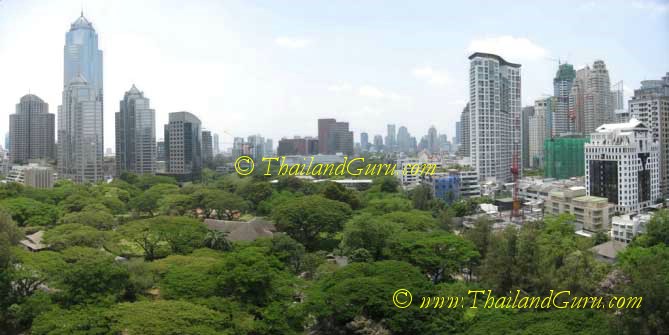
Green space is an issue in many parts of the city center, but there are a few parks, regions with royally owned land, embassy compounds, Buddhist temples, and even a few nice old neighborhoods you can look over.
You should choose your location and home very carefully because it will have a major impact, good or bad, on your Thailand experience and that of your family, in many ways. Analysis in advance is time and effort well spent in leveraging a most fruitful Thailand experience.
The purpose of this section is to give you a general orientation to Bangkok and its regions, show you the most popular expat business and residential locations, as well as introduce you to some of the less conventional but nice places where some expats live off the beaten track, and attempt to give you a general feel for Bangkok and its different regions.
My real estate agency mentioned in various places on this page and website (in addition to some other expat support services such as a Thai-English professional translation agency, company setup services, and other things) was set up in order to help expats find the best homes according to their particular needs and preferences. In 1995, I started working for engineering and construction companies, then property developers, and enjoyed the diverse locations, styles, and niches, in addition to my usual love of exploring the nooks and crannies of Bangkok, hence this website since the year 2000, and my kkBkk.com real estate website since 2005.

We usually start with the simple choice of type of property (apartment, house, etc.), then location, and finally style of home and community.
Your choice of type rental properties are:
- Apartments - have a much higher percentage of foreigner occupancy than condominiums, have routine maintenance and support staff for occupants if you need them, and on average are a little more expensive than rented condos.
- Rented condos - tend to have more settled and less transient occupants, and offer a wider selection of styles and prices.
What is the difference between an "apartment" and a "condominium"? All units in an apartment building are owned by one corporate owner who rents out all of them. In a condominium building, the developer sells all units to individual owners, whereby some owners live in their unit but other owners rent out their units.
- Serviced Apartments - are like a long stay hotel in extra on-site service and amenities such as a nice restaurant within the complex, and they accept short leases unlike the above two. The prices are more expensive than the above but less than a hotel.
- Houses - in the suburbs, offer the greatest amount of space for a given price, but houses around the CBD are significantly more expensive per square meter and far less in supply. Most houses in the CBD are quite old, while the opposite is currently true in the suburbs as neighborhoods popular with expats.
- Townhouses - similar to houses but scaled down in price, are the least popular but some nice complexes do exist in the CBD for significantly lower prices than a house with a big yard.
Within the Sukhumvit-Silom "central business district" (CBD), there are literally hundreds of highrise condos and serviced apartments that expats live in (not counting purely Thai places), with a wide range of prices, amenities, styles and building ages. Most expats depend upon the guidance of a good real estate agency to find the best serviced apartment, rental condominium, or house.
Modern new highrise buildings dominate the central business district region.
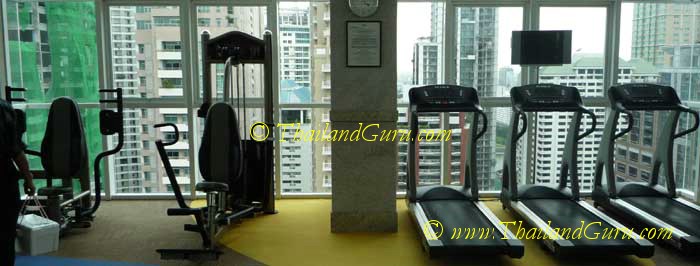
Here's the view from an eclectic condominium building's fitness room:
Apartment and condominium buildings normally come with a sizeable pool, sometimes a little bit of green space for a playground or outdoor lounge area, sometimes sports such as tennis courts, indoor squash, and ping pong, and occasionally golf driving into a net, and basketball.
(Photo below: Infinity swimming pool in a highrise condominium.)

Many houses exist in and around the central business district, but there are no large neighborhoods, and the vast majority of the houses are old, though many do get renovated. Some small housing compounds are scattered around, but large gated community neighborhoods don't exist until you get out into the suburbs outside the skytrain/subway coverage. Modern new gated communities have sprouted up in abundance over the past 10 years around the new expressway network. The central region filled up long ago, and land prices skyrocketed, with new highrises typically going up after demolition of houses on the land.
You will need to look in the suburbs if you have a moderate budget for a house, or want a modern house with a yard and a place for the kids to ride bicycles and walk around a peaceful neighborhood. A modern new expressway system was completed in the late 1990s, with resulted in a surge in construction of nice neighborhoods with clubhouse and full amenities. These are most popular for families with children.
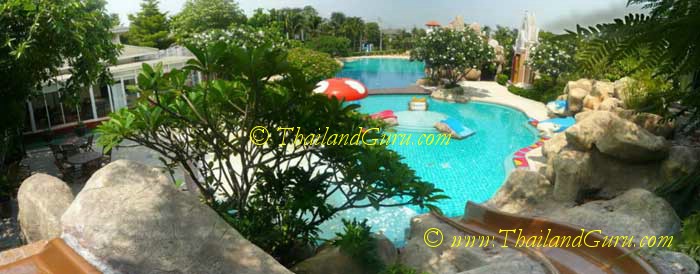
The suburban housing communities normally come with a clubhouse which features a pool, fitness center, and various other amenities. Unlike in some other countries like China, these houses and communities are NOT wholly owned by any entity. They are modelled after communities in the USA and many other countries whereby the plots of land are individually sold, the developer builds the clubhouse and amenities to increase the value of the land, and some juristic entity takes over and collects a small maintenance fee from the residents (in the case of rental properties, normally covered by the landlord, i.e., included within rent) to pay for security guards, gardeners, facility maintenance, etc. These gated communities usually run well, as is proven by the older ones, with few exceptions.
This is the community swimming pool including two water slides in a Bangkok neighborhood where we have many houses for rent. Not shown is the cave where the pool lets you sit in the shade on tiled seating in the water.
However, if you plan to commute into town, you should know which parts of the "expressway" are often jammed at what times, where the skytrain and subway go, and what other modes of transport are available (e.g., private and public expressway vans to a skytrain station).
Houses exist in the central region, but not big bicycle riding "neighborhoods" like the above, with a few exceptions.
In my 15+ years here, I've been saddened to see countless nice houses demolished and old trees felled in the CBD to make room for another residential highrise or a commercial building. The value per square meter for land in the CBD is simply too high a temptation for owners, and many developers who have utilization in mind for that area are usually knocking on their door.
Most detached houses remaining in the CBD are unaffiliated with neighboring houses, though they tend to exist in small batches of a few to a dozen or so alongside each other, without any common facilities.
However, there are some nice townhouse compounds, a few sizeable compounds of new detached houses (and generally the highest priced in Bangkok), and a good number of small compounds of just a few houses.
In contrast, suburban houses generally exist in gated neighborhoods, the entire neighborhood having been built recently by one developer, with a shared clubhouse, fitness center, playground, park area, and other facilities, and the kids can ride their bicycles around on the streets. Security guards patrol on bicycles using 2 way radios, and people entering must state their destination. These sizeable neighborhoods generally exist down the expressways, not within walking distance of the skytrain or subway, with just a few exceptions.
Many of the big luxurious standalone homes in the CBD are occupied by wealthy Thais who really want to live there and don't need the money, neither selling the land to developers nor becoming rental properties.
Condominiums and apartments are an entirely different story.
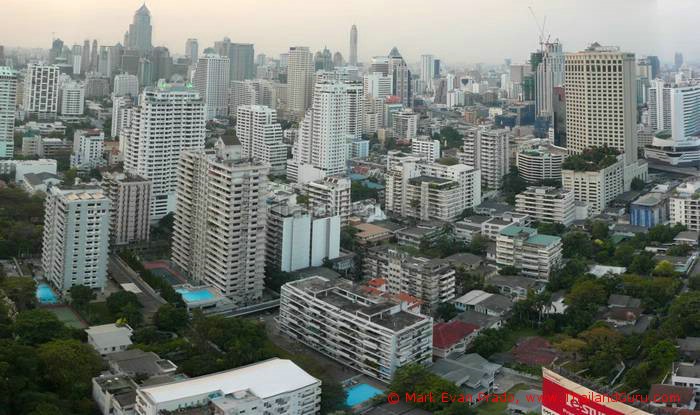
Photo above: Sukhumvit residential district, sois 4 to 14.
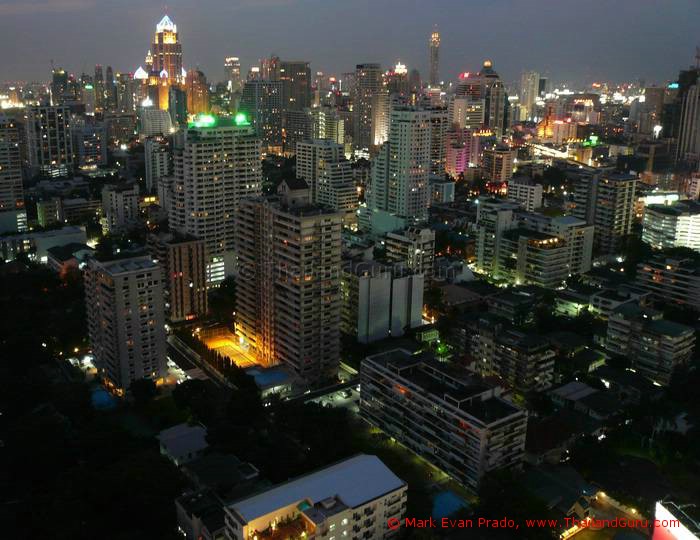
Photo below: Sukhumvit residential district, sois 4 to 14, at night.
Bangkok has a very large selection of condominiums for rent. To understand why, you need a one-sentence overview of the Thai economy: You may be surprised to know that Thailand's GNP since the mid 1990s has been about 66% exports, 6-7% tourism (lower recently), and the other 25-30% purely domestic, in terms of dollar value.
Thais are traditionally heavy investors in property, especially owners of export factories who often have far more money than they know what to do with. You may have already noticed that Thai bank accounts offer negligible interest. Many wealthy Thai people buy condos and houses as investment properties, which have appreciated in value many times faster than bank interest rates, with any rent collected being a bonus. The overall equation makes property investment much more attractive than money in the bank. It is also common for wealthy Thais to buy a property for their young children or relatives and rent it out until they grow up (but after they grow up, the children often have other ideas about where they want to live...).
However, for westerners, investing in a property in Thailand is a different matter. Foreigners can only own a condominium freehold, and even then, can buy a condo only if the building is less than 50% foreign owned (by square meters of floor space). Foreigners cannot own land under a house. Thus, condominiums are usually the property of choice for foreigners. However, the condominiums must be fully paid in advance, generally speaking, and mortgages to foreigners are very hard to come by ...
Condominium prices here are much lower than many other cities in the region, and Bangkok is generally regarded as a fairly solid investment with a high probability of decent returns and not difficult to resell as long as you choose a good location and unit in a well maintained building (another long story in itself...).
Foreigners cannot own land under a house, and can only lease it for 30 years (with an option for a renewal and other legal twists, but it's still a lease, not a title deed ... and there's also the similar usufruct arrangement ...). There are various methods and associated risks and complications to control land which I'd rather not get into in an introduction, but can discuss in detail elsewhere.
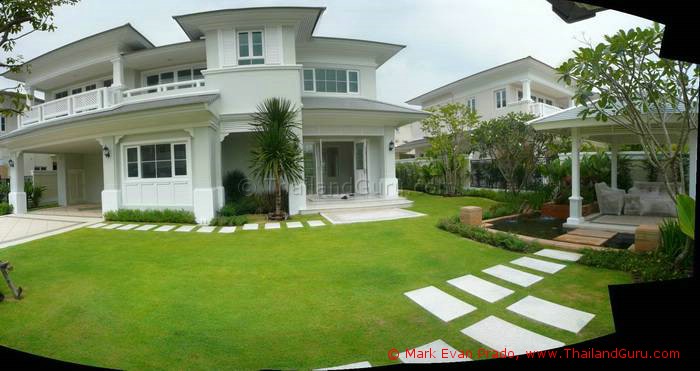
Above photo: Suburban houses in a new neighborhood.
Foreigners cannot own land & house, but can only rent or 30-year lease.
Some neighborhoods have many copies of the same design, like cranked out of a factory (see adjacent house above).
Others have a wide variety of custom and very artistic styles.
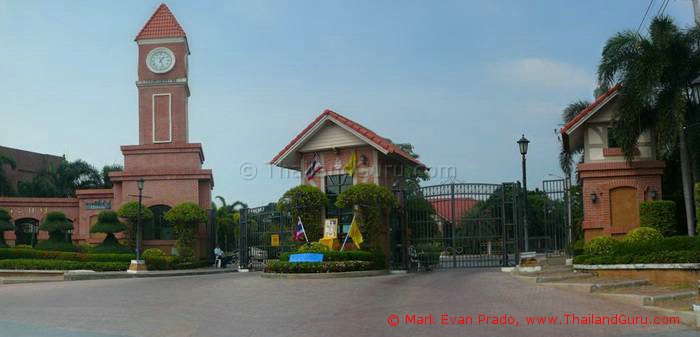
The entrance/exit gate of a gated neighborhood, just drive up with the sticker on your car, or otherwise identify yourself as a resident or a visitor to a specific house address and leave a form of identification, and the guards will open the gate and let you in or your visitor(s) (and sometimes check their car):
In summary, if you are dealing with a house, you will be dealing with a Thai landlord, and this will usually but not always be the case for a condominium as well.
We generally deal with four kinds of people:
- Renters in Bangkok for 1 to 5 years
- Retirees looking for a place to buy rather than rent
- Foreign husbands of Thai wives, with and without children (renters and buyers, e.g., Thai wife owns)
- Investors looking to buy the property to rent out to any of the above
Generally, all these matters, and others, are best discussed with a property agent, such as myself or one of my staff at Prado Property Co., Ltd., for Bangkok apartments, condominiums and houses for rent and for sale.
Expats often waste a lot of time & effort going around in the traffic and heat, then dealing with the Thai language barriers, in search of an available condo or house to their specifications and preferences.
If you are not real familiar with Bangkok, if you don't have a lot of time & energy to burn, and especially if you want to find the best home, then you may want to consult a housing specialist who maintains a database of the good quality condominiums and serviced apartment buildings and keeps updated on the available units in each, as well as good houses in the metro region. Such as us at Prado Property Co., Ltd.
We have a number of Thai agents who each specialize in their own region, and we also liberally "co-agent" with other agents who specialize in their own area within the vast Bangkok metropolis. I often give the general advice, and then hand people over to the agent(s) of one or more regions.
Unlike in some countries, the vast majority of Thai owners of condos and houses do not sign an exclusive agreement with any real estate company, but instead just advertise their homes in various other ways. Professional real estate companies have networks of people who maintain private, in-house listings of condos/houses/other properties -- usually nonexclusive -- which are very dynamic. The best real estate agencies have fulltime employees who also liberally coagent with experts in the different subregions of the vast Bangkok region, to give home shoppers the best selection.
These agents and agencies will also maintain contacts with condo building managers and others related to these properties, who update them when a condo becomes available for rent or sale at the moment, as well as housing estate managers. These networks can be very longstanding, personable, interlinked with an extensive real estate community, and established trust and carefully maintained reputation. In Thailand, a network of contacts is important in more ways than one!
The best rental properties go quickly, so that any database is usually incomplete (nobody has yet had time to go out to take photos and details, and upload them to the on-line database), but an agent familiar with the area will know of many places not yet in any database.
The first stage is first determining the region(s) the client is most interested in, by discussing their needs, preferences, styles and budget.
If you are looking for a home, then it is strongly advised that you use a professional real estate guide to save you time, energy and frustration, as they can nicely help you find the best selection of homes for your specifications and preferences, as well as deal with the Thai language barrier. It is a major investment, and it is your home.
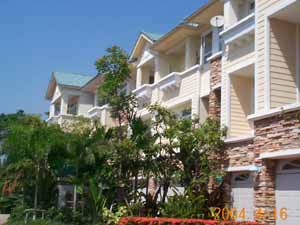
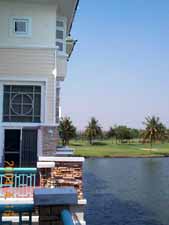
Our property company at kkBkk.com (Knock Knock BangKoK) lists thousands of properties in Bangkok which are to foreigner standards of quality and amenities, for rent or to buy.
We also are aware of many additional rental properties which haven't yet been added to any on-line database.
Prado Property Co., Ltd., employs English speaking Thai real estate agents (some of whom have lived overseas before) and an expat (myself). Each Thai agent has their own region of specialization, whereas I am relatively quite familiar with the Bangkok region as a whole. Together, we can show you a wide selection of "homes" (houses, condos, and apartments).
It is impossible for one person to cover all of Bangkok and do a decent job of it. Indeed, we have multiple people covering just the Central Business District, and a multitude of people in the suburbs, each responsible for their own particular area.
I have lived in Thailand continuously since 1994, and have stayed in the suburbs of Nonthaburi, Bangkapi, and Pathum Thani, as well as in highrises on Sukhumvit Road in the expat regions, at different times, and stayed in rural areas upcountry for awhile from time to time. I've worked in projects in additional areas, and love to explore Bangkok (though I must say that many places are nice to visit but you couldn't live there!). (I've also visited most countries in Asia.)
There is so much to cover that it's best to just talk about it all in person as regards one's particular needs and interests, rather than try to cover everything in a website.
Indeed, I already have more than 10 years of writings on this website. (I enjoy exploring and writing, in case you hadn't noticed...) However, I generally focus on what is of particular interest to someone's needs, in person.
There are numerous factors which go into finding the best home for you, such as location, budget, size, public transport access and/or commute issues, local conveniences, environmental preferences, style of decor, furnishings, and so on. You should be understood and shown the kinds of places for you.
As we show you the first properties, you can give us feedback on what you like and don't like, and we can refine the search based on that.
The same goes for regions. Customers often explore the different regions first, especially in suburban Bangkok, before settling upon a region and then starting to narrow down the selection for a home in that particular region.
The Bangkok housing market generally consists of:
- The Central Business District (CBD), which has mainly condos and serviced apartments, but also some houses and townhouses scattered among the highrise and business area, usually right along crowded subsois and not in "estates" or "villages:
- Suburban "villages" or housing estates which usually are planned neighborhoods from the start, and are quiet, quite a bit more spacious, and have clean air
- Suburban highrise condominiums and apartment buildings scattered around (not many, but this covers everything)
Factors that go into a decision on where to live may include:
- Work location
- Whether you drive, need skytrain or subway access (inner city), or take other public transport
- Personal preferences in style of housing
- Schools for children
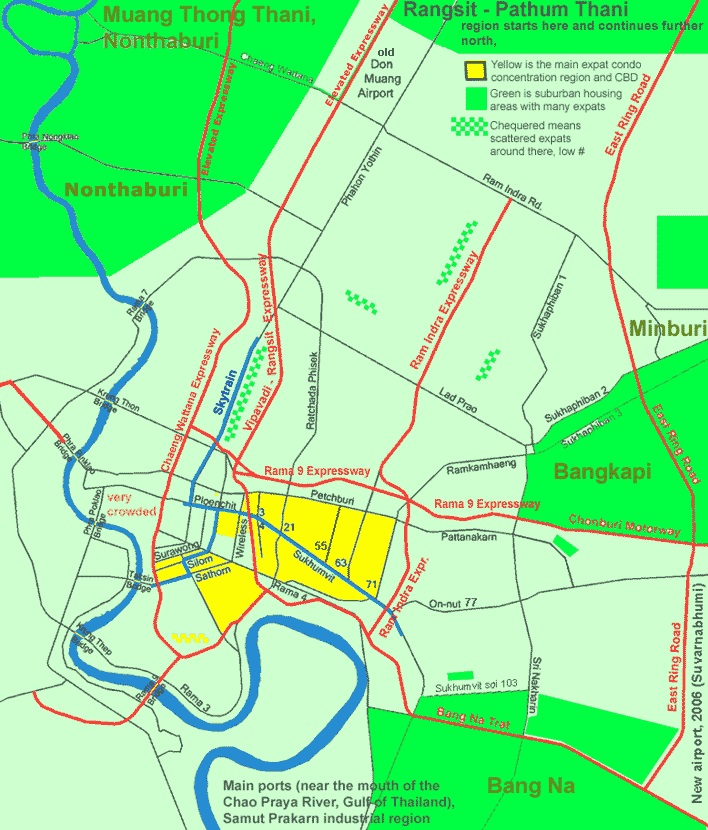
Of the expats who live and work in Bangkok, probably around half are in the central business district (CBD), namely at the beginning of Sukhumvit Rd. and in the Silom and Pathumwan-Lumpini areas, as shaded in yellow on the map below, shaded in yellow, near the bottom. This region is mostly highrise office buildings, condominiums and apartments.
Click here for a list of condos, apartments, and houses near the skytrain courtesy of kkBkk.com
Of course, the rest are in the suburbs. There are certain suburban regions preferred by expats, due to the nice modern housing villages, general environment and access to the expressways, as shown in a different shade of green below. These are not the only areas that expats live in, but from our experience, about 90% of suburban expats live in one of the shaded regions. However, with nice new housing villages being created in some new regions, this will change over time.
You can click on some of the areas of interest on the map below, which will send you to the corresponding page. Each page both describes the region and lists specific homes -- houses, townhouses, condos and apartments for rent and for sale in that region. Just click on any region of darker green or yellow.
- Bangkok Central Business District (CBD)
- Bang Na (southeast)
- Bangkapi-Minburi (northeast)
- Nonthaburi, Muang Thong Thani (northwest)
- Rangsit-Pathum Thani (north)
- Ram Indra expressway off Rama 9
If you have children, then you should also see the section on schools.
To view some specific properties, please visit kkBkk.com
I tried to keep this page brief, but I have some extra notes for people looking for a house for rent in Bangkok.
Likewise, there are notes on condominiums and apartments for rent in Bangkok.
For anything else, you can email the Thailand Guru here
 > Regions, Condos, Houses, Apts > Bangkok Region Introduction
Additional, children pages of this current parent page:
Bangkok Region Introduction :
Central Business District
Bangkok Suburban Regions
Bang Na, Suk. 101-107, SriNakharin
Bangkapi, Minburi
Rangsit, Pathum Thani
Nonthaburi, Muang Thong Thani
Bigger map
Ram Indra - Ekamai
Copyright 1999 -
2024 by Mark Evan Prado, All Rights Reserved.
Notably, I get quickly notified of copies of tracts by the CopyScape / CopySentry automatic search engine & notifier.
Short quotes are often OK and can be approved, if there is a clear reference and web link back to my website from the quoted material, and if you send me a short message. I try to help people with good intentions, and try to help the world. Not thieves. Links back to this website are helpful for sustainable progress, thank you!
Please have honor and class by following intellectual property and internet protocols. Be a good kind of person in life.
|
Want to privately ask the Thailand Guru? Contact us.
|
|
Some of the services discussed on Thailand Guru are provided by our friendly staff in our 2 companies: |
|
|
Lucky Lion Pride Co., Ltd.
|
|
| DISCLAIMER: Although efforts have been made to ensure the information on this website was correct at the time of electronic publication, ThailandGuru and all its associates do not assume and hereby disclaim any liability to any party for any loss or damage caused by errors, omissions or misleading information resulting from negligence, accident or any other cause. If you choose to take any of this advice, it is at your own risk and no other entity's. ThailandGuru and its associates will take no responsibility. The only thing we guarantee is that our website information can take bandwidth, memory and/or disk space, at least temporarily. Guru is relative. | |
Menu: Site Map